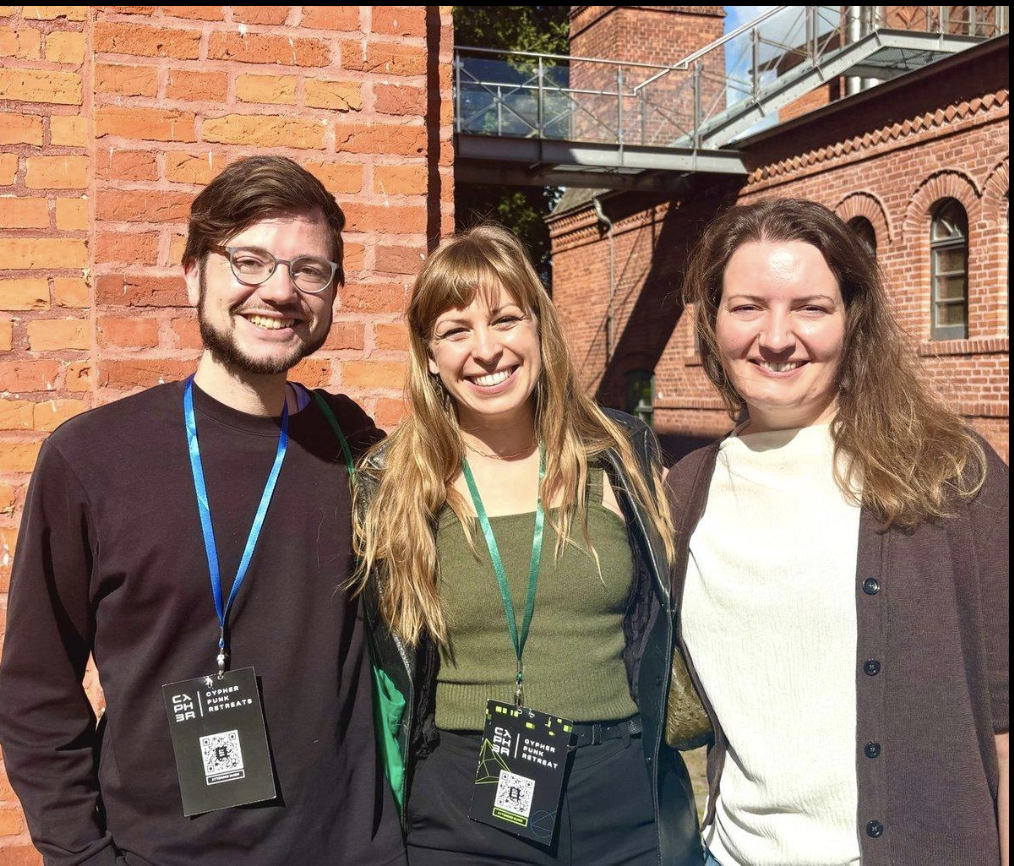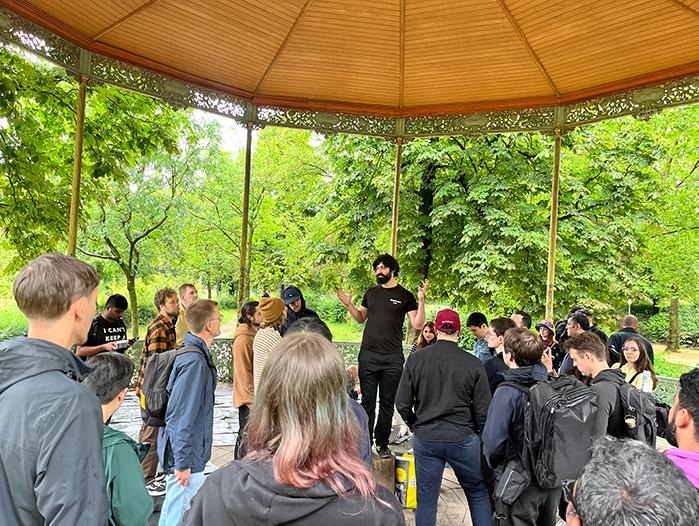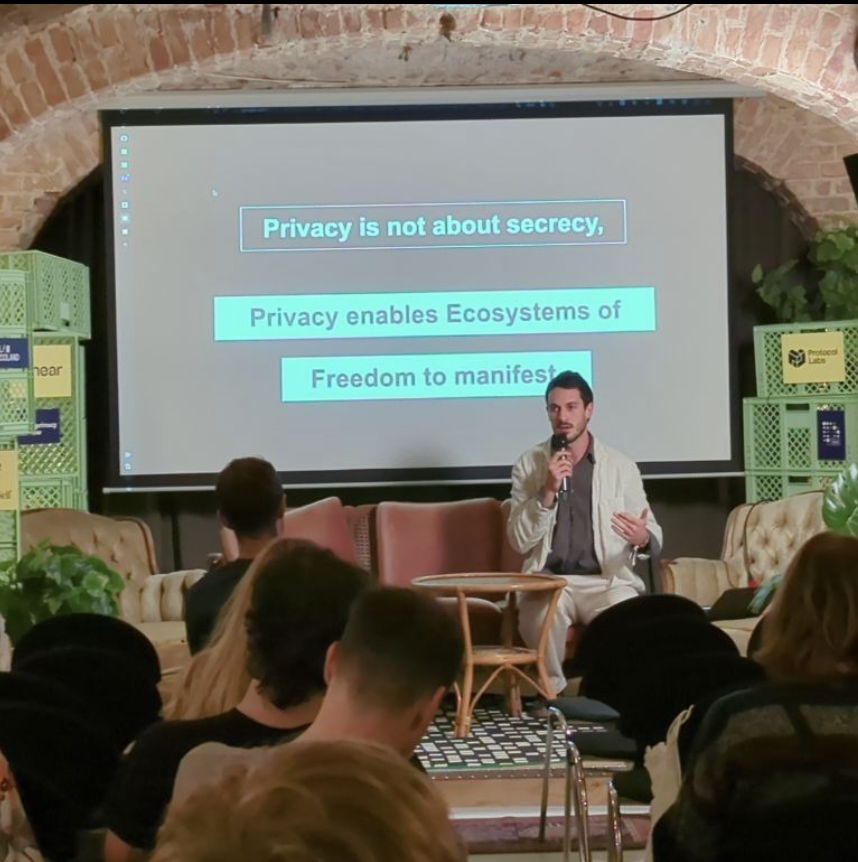
Gathering at Berlin's historic Funkhaus, the Neocypherpunk Summit brings together a global network of hacktivists, researchers, technologists, whistleblowers, philosophers, lawyers & policy-makers.
From defending resistance networks under political duress to scaling cryptography as civic infrastructure, the summit explores how open protocols and privacy tools become a resilient, shared foundation for digital autonomy, free assembly, and accountability.
What to Expect
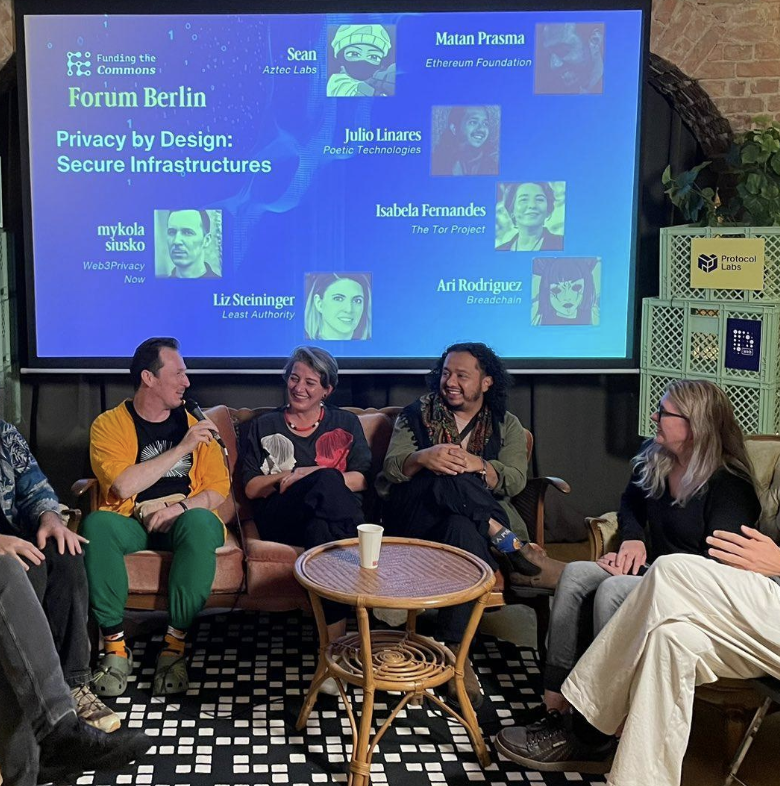
Dialogue
Discourse to identify and bridge gaps in knowledge, alignment, values and vision.

Knowledge Exchange
Develop skills, strategies and intuition for hacking, organizing and advocacy.

Rituals
Activations and participatory programming inviting exploration through creativity and play.

Field Building
Nourish a cross-disciplinary community of practice exploring how privacy mediates power.

Showcases
Discover bold ideas, meet the makers, and explore innovations shaping the future.

Debates
World-class leaders go head-to-head, rethinking the systems and norms that shape our world.
Discourse to identify and bridge gaps in knowledge, alignment, values and vision.
Develop skills, strategies and intuition for hacking, organizing and advocacy.
Activations and participatory programming inviting exploration through creativity and play.
Nourish a cross-disciplinary community of practice exploring how privacy mediates power.
Discover bold ideas, meet the makers, and explore innovations shaping the future.
World-class leaders go head-to-head, rethinking the systems and norms that shape our world.
Neocypherpunk Themes
Cryptography as Civic Infrastructure
How do privacy tools become essential infrastructure for democratic participation serving technologists, journalists, organizers, and citizens?
Encryption, anonymous communication, and verifiable credentials are no longer niche concerns. Digital systems have become ubiquitous surveillance machines and cryptography is our defense. Applied cryptography functions as civic infrastructure: enabling whistleblowing, protecting protest movements, securing elections, and preserving press freedom.
Resistance Networks
How can privacy infrastructure be maintained under political duress to ensure the resilience and censorship-resistance of social movements?
This theme centers practical, field-tested approaches to censorship circumvention, mesh networks, and secure coordination in hostile environments. It foregrounds the people deploying these tools in the hardest conditions, asking what builders need to hear from them about case studies, operational security, and the gap between what exists and what's needed.
Open Protocols & Digital Autonomy
How do open protocols and p2p systems reshape power dynamics on the internet?
The open social web, federated infrastructure, and peer-to-peer architectures offer alternatives to extractive platforms and surveillance wrapped as advertising. This theme explores stack independence, protocol governance, interoperability, and practical shifts from centralized services to digital autonomy.
Digital Rights & Legal Defense
How do current legal and regulatory frameworks impact the right to privacy, and what strategies are being used to navigate these changes?
As state security mandates increasingly clash with civil liberties, a coordinated defense is no longer optional. This theme maps the shifting regulatory landscape from EU Chat Control to global digital identity schemes. We explore the legal strategies human rights lawyers, researchers, and technologists are using to safeguard the right to privacy.
Privacy for the Commons
What strategies can we use to embed privacy as a collective habit instead of an individual burden?
Privacy is often framed as personal protection. This theme reframes it as a public good, examining community threat modeling, collective data stewardship, mutual aid security practices, and the cultural work of normalizing encryption. The central question is how those that need it the most can adopt privacy infrastructure at critical mass.
AI, Power & the Surveillance Economy
What is the relationship between AI development and mass surveillance, and what does a privacy-respecting alternative look like?
The AI industry was built on the infrastructure of the surveillance economy: the same data collection pipelines that have tracked users' behavior at scale trained the models reshaping public life today. This theme examines how AI systems extend surveillance with new surface areas for attacks, how power is concentrating, and what it takes to build AIs that respect the digital commons.
How do privacy tools become essential infrastructure for democratic participation serving technologists, journalists, organizers, and citizens?
Encryption, anonymous communication, and verifiable credentials are no longer niche concerns. Digital systems have become ubiquitous surveillance machines and cryptography is our defense. Applied cryptography functions as civic infrastructure: enabling whistleblowing, protecting protest movements, securing elections, and preserving press freedom.
How can privacy infrastructure be maintained under political duress to ensure the resilience and censorship-resistance of social movements?
This theme centers practical, field-tested approaches to censorship circumvention, mesh networks, and secure coordination in hostile environments. It foregrounds the people deploying these tools in the hardest conditions, asking what builders need to hear from them about case studies, operational security, and the gap between what exists and what's needed.
How do open protocols and p2p systems reshape power dynamics on the internet?
The open social web, federated infrastructure, and peer-to-peer architectures offer alternatives to extractive platforms and surveillance wrapped as advertising. This theme explores stack independence, protocol governance, interoperability, and practical shifts from centralized services to digital autonomy.
How do current legal and regulatory frameworks impact the right to privacy, and what strategies are being used to navigate these changes?
As state security mandates increasingly clash with civil liberties, a coordinated defense is no longer optional. This theme maps the shifting regulatory landscape from EU Chat Control to global digital identity schemes. We explore the legal strategies human rights lawyers, researchers, and technologists are using to safeguard the right to privacy.
What strategies can we use to embed privacy as a collective habit instead of an individual burden?
Privacy is often framed as personal protection. This theme reframes it as a public good, examining community threat modeling, collective data stewardship, mutual aid security practices, and the cultural work of normalizing encryption. The central question is how those that need it the most can adopt privacy infrastructure at critical mass.
What is the relationship between AI development and mass surveillance, and what does a privacy-respecting alternative look like?
The AI industry was built on the infrastructure of the surveillance economy: the same data collection pipelines that have tracked users' behavior at scale trained the models reshaping public life today. This theme examines how AI systems extend surveillance with new surface areas for attacks, how power is concentrating, and what it takes to build AIs that respect the digital commons.






























































Speakers





























ANNOUNCED SOON
Speaker application coming soon. Email events@web3privacy.info with questions.
What is Neocypherpunk?
The cypherpunk movement, rooted in Eric Hughes' 1993 manifesto, held that cryptography is a political act: writing code to protect privacy is itself resistance to centralized power. That conviction produced PGP, Tor, BitTorrent, and ultimately Bitcoin and Ethereum. But its emphasis was on the sovereign individual, the lone cryptographer building tools in defiance of the state.
Neocypherpunk carries that conviction forward while expanding who it's for. Where the original cypherpunks built for rugged individuals, neocypherpunk insists that privacy must be practiced collectively to be sustained. Encryption, open protocols, and decentralized infrastructure are shared resources, maintained and defended by communities. The goal is not withdrawal from public life but building the conditions under which movements and ordinary people can communicate, organize, and hold power to account without being surveilled, silenced, or captured.
Discover more about the neocypherpunk movement in essays by Vitalik Buterin and Project Glitch.
About Funkhaus


Funkhaus Berlin was built in the early 1950s as the DDR's broadcasting headquarters, designed by Franz Ehrlich, a Bauhaus-trained architect and communist who had been imprisoned in Buchenwald for his antifascist activity.
The DDR treated it as a demonstration of cultural ambition, marrying Bauhaus functionality with monumental Soviet-era scale: Saal 1 remains the largest purpose-built recording studio in the world, with house-in-house construction so precise that even overhead aircraft could not be heard inside.
Artists including Aphex Twin, Nils Frahm, and Depeche Mode have performed and recorded here.
At Funkhaus, the medium is the message, inviting guests inside its sonically optimized architecture to experience the dissonance and interdependence between communication and control that informs Neocypherpunk.
Thank you to the Funkhaus team and Zuberlin for hosting us here!












Support key privacy & digital rights event